

Kampala, Uganda | The National Resistance Movement (NRM) Parliamentary Caucus has unanimously resolved to support the Government’s harmonised position on the Protection of Sovereignty Bill, 2026, ahead of Parliament’s expected consideration of the controversial legislation this afternoon.
The resolution was reached during a special caucus meeting chaired by Government Chief Whip Hamson Obua at the Office of the President Conference Hall on Tuesday morning.
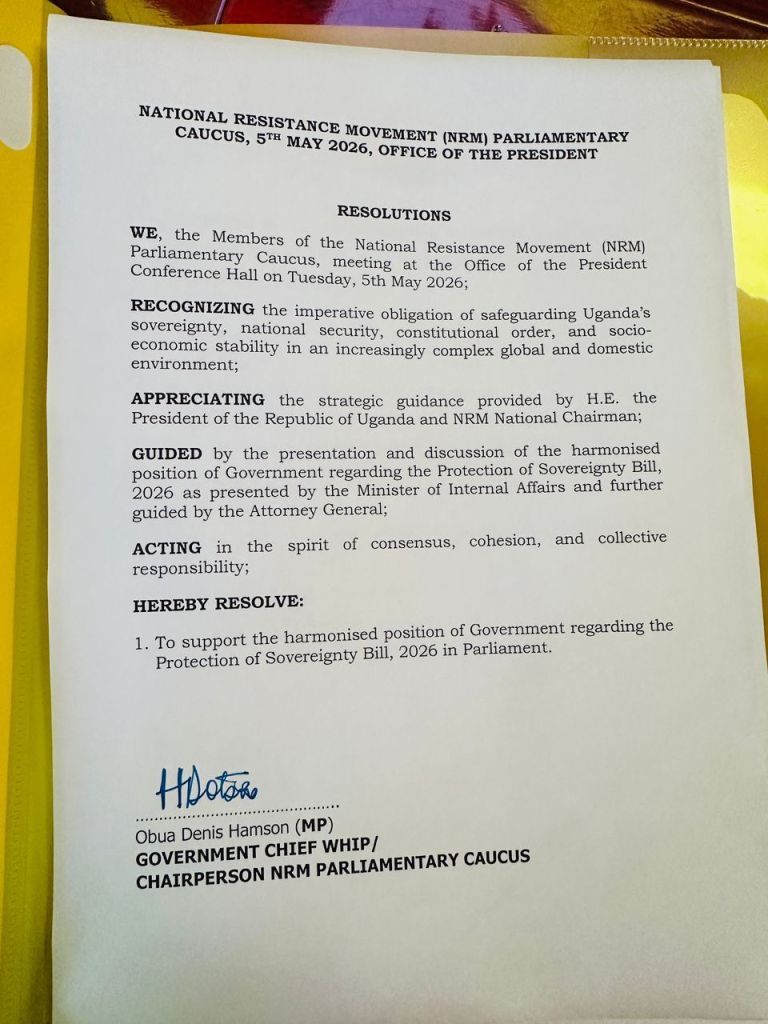
In the resolution signed by Obua, who also chairs the NRM Parliamentary Caucus, members recognized the need to safeguard Uganda’s sovereignty, national security, constitutional order and socio-economic stability amid what they described as an increasingly complex global and domestic environment.
The caucus noted that members are guided by presentations and discussions led by the Minister of Internal Affairs and the Attorney General regarding the Government’s harmonised position on the Bill.
The legislators subsequently resolved to support the government position on the Protection of Sovereignty Bill, 2026, when it comes before Parliament.
Background to the meeting shows that Obua had on May 4 issued an urgent notice summoning all NRM MPs and NRM-leaning independent legislators to a special caucus meeting ahead of Tuesday afternoon’s plenary sitting.
In the notice, members were informed that the caucus would convene at the Office of the President at 9:30am before Parliament resumed at 2:00pm to handle business related to the Bill.

Obua also urged all members to attend the meeting physically, underscoring the importance of the government attached to building consensus within the ruling party before the parliamentary debate.
The caucus further appreciated the strategic guidance of President Yoweri Museveni, who also serves as the NRM National Chairman, in shaping the Government’s position on the proposed legislation.
The Protection of Sovereignty Bill, 2026 has already sparked intense public debate, with supporters arguing that it is necessary to shield Uganda from external interference and protect national interests, while critics have raised concerns over its possible implications on civil liberties and democratic space.
With the ruling party caucus now adopting a common position, attention shifts to Parliament, where legislators are expected to engage in one of the most closely watched debates of the year.